
The 63rd 2025 New York Film Festival did not disappoint. I count at least eleven films I loved and many more I would still recommend. One of my favorites is about a film director who has been a mainstay of the festival since its first year.
Richard Linklater’s “Nouvelle Vague” is a passion project, a well-researched and exhilarating recreation of the shooting of Jean-Luc Godard’s debut feature, 1960’s “Breathless.” “All you need for a movie is a girl and a gun,” the half-wise/half-glib journalist Godard (Guillaume Marbeck) announces when he finally gets to join his friends (Truffaut, Chabrol, Rohmer) at the Cahiers du Cinéma who have already moved over into filmmaking. (He is particularly jealous of Truffaut’s huge success with his “The 400 Blows.”) Despite a low budget he convinces Hollywood It girl Jean Seberg (an ebullient performance by Zoey Deutch) to co-star with Jean-Paul Belmondo (Aubry Dullin). The production is highly unconventional. Godard drives his producer crazy by his capricious delays and skipped days as he trusts his intuition to create a film from a bare outline. When the film is too long he instructs his editor to cut anything that seems boring, resulting in the famous “jump cuts” that helped the film to become a watershed in film form. For fans of French film, Linklater’s black-and-white film is an occasion to have one’s expertise rewarded as dozens of filmmakers, technicians and personalities of the French New Wave are identified with on-screen titles. And the production design and period look are superb.
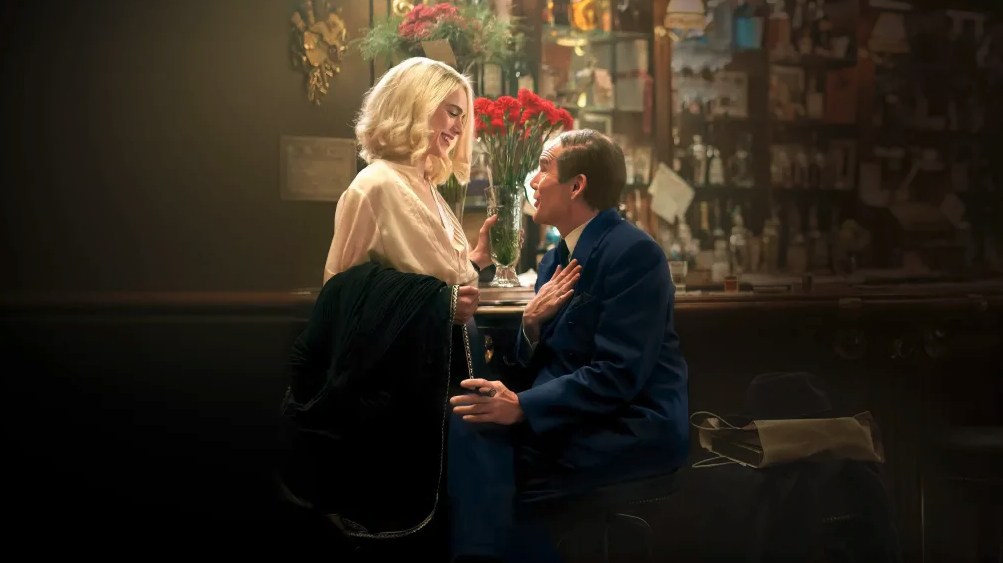
“Blue Moon” is Linklater’s second film showcased at this year’s festival. Ethan Hawke turns in an Oscar-worthy performance as Lorenz Hart, the brilliant lyricist who, with composer Richard Rogers (a splendid Andrew Scott), wrote dozens of successful musicals in a 20-year partnership. It’s the opening night of “Oklahoma!”–a musical Rogers has declined to use Hart as his lyricist. Hart has left the show early on (he calls it “fraudulent on every possible level”) to drink whisky for hours at Sardi’s while waiting on Rogers and others to arrive after the show. A bartender (the always good Bobby Cannavale) entertains his favorite customer, serving him drinks long after he should cut the desperately alcoholic Hart off. Lorenz is bitter, feeling his partnership with Rogers is over. He’s also smitten with a beautiful woman much younger than him, Elizabeth (a radiant Margaret Qualley) but he has no chance of leaving the friendship zone; besides the age issue he’s also very short. Hart will die a few months later after being hospitalized for alcohol abuse. Despite the tragic outcome the film portends, it’s still an enjoyable long night’s journey into the heart and soul of a great American artist. And a generous one too: Hart gives writer E.B. White the idea for what would become one of his most successful novels.
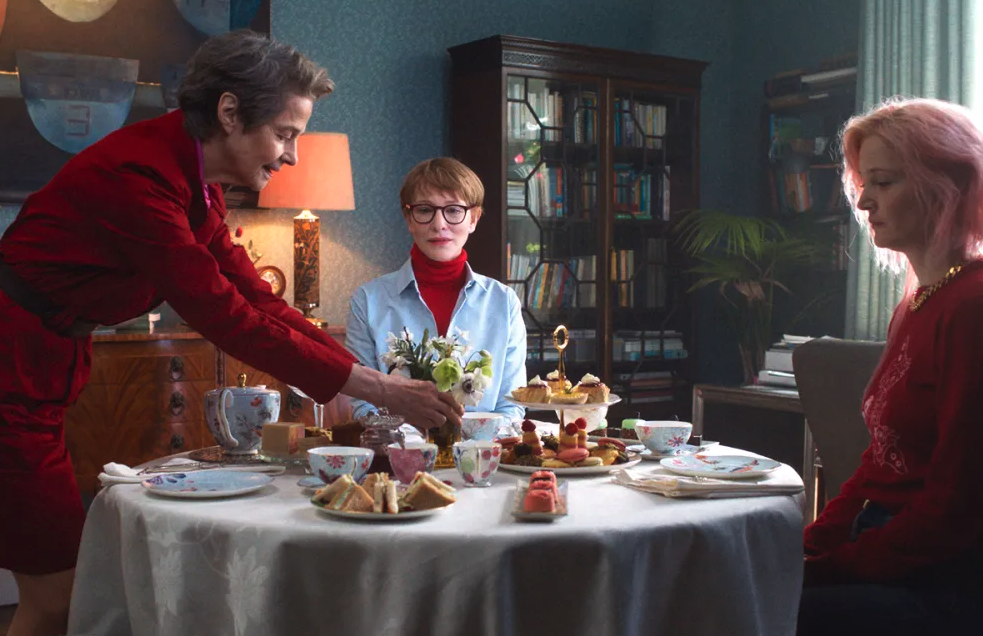
Jim Jarmusch’s “Father Mother Sister Brother” is an anthology of three short films about awkward relations between parents and children. The first story begins with Jeff (Adam Driver) and his sister Emily (Mayim Bialik) driving to visit their elderly, divorce father (Tom Waits, a frequent Jarmusch collaborator). There are some tense moments as the two discuss what they are expecting from their checkup on their dad. There are some funny, even more tense minutes with the father at first but things are settled by a generous money gift to him. A surprise ending suggests that the father is not being honest about his lifestyle. The second story is set in Dublin. Charlotte Rampling plays a mother preparing for the annual visit of her two daughters Timothea (Cate Blanchett) and Lilith (Vicky Krieps). Lilith misrepresents herself as a successful influencer while Timothea seems to have always been obliged to compete for their mother’s attention. All three actors are sublime in this part as they gradually reveal decades of mutual fears, suspicions and dreads–that’s why they meet only once a year! The final story takes place in Paris. Two adult twins grieve for their parents, who recently died in a plane crash. The tone of the work moves from dry humor to sad acceptance to nostalgia; it’s a wonderfully humane and wise meditation on family relations.
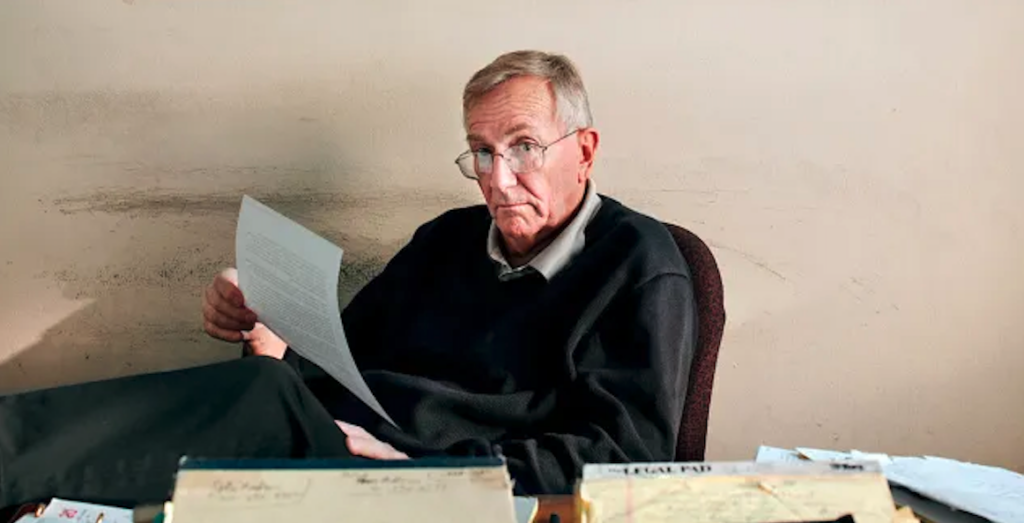
I’m a big fan of the legendary investigative journalist Seymour Hersh (beginning with his 1970 book “My Lai 4,” which I read in high school) so even an average documentary about him would be a must-see for me but Laura Poitras’s “Cover-Up” is a brilliant doc about the man who broke the stories of the My Lai massacre, the Abu Ghraib Iraq prison scandal and many more in a 47-year career. Hersh tells the fascinating story of his life as a journalist, from small city newspapers to stints at the New York Times and the New Yorker magazine. At one point, surprised at some of the documents the director was able to acquire, he almost halts his cooperation with the project. Fortunate for us, he decided to stay on.
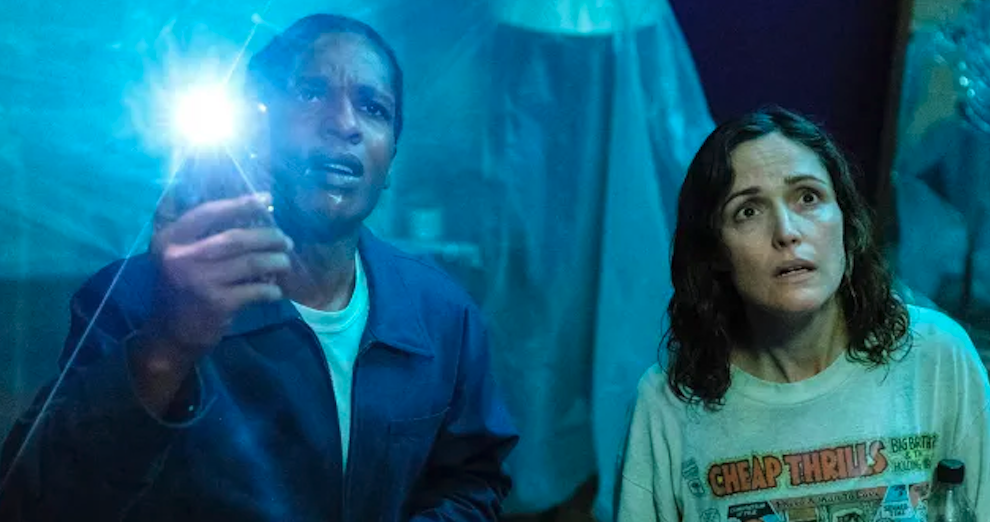
Mary Bronstein’s “If I Had Legs I’d Kick You” is a wickedly funny maternal angst film with a furiously good lead performance by Rose Byrne. (She’s having a bit of a renaissance in recent years.) Byrne plays Linda, a therapist and mother to a young girl who is suffering from a rare disease. A leak leads to part of Linda’s ceiling to collapse, sending them to a motel to live. And yet no one seems very worried about Linda. Not her husband (Christian Slater, only heard on the phone) who is a cruise ship captain away for months, nor her supervisor (played by Bronstein). Her own therapist (a great surprise performance by Conan O’Brien) is bored by her problems and frequently chides her. The only person who gives her any emotional support is her motel super James (ASAP Rocky). The tension is racked up by Filipe Messeder and Ruy García’s creepy, whooshy sound design.

Jafar Panahi’s “It Was Just an Accident” is a caustically funny political thriller about a group of contemporary Iranians who kidnap and plan to exact revenge on the man they believe tortured them all when they were political prisoners. The victims argue about how certain they are that the man they’ve kidnapped is the right man. Complications and more doubt make for a long series of often comic adventures. Panahi filmed this in Iran without official permission. It’s a brilliant and entertaining portrait of daily life in a repressive regime.

Ex-New York Film Festival artistic director Kent Jones returns with “Late Fame,” a dramedy about Ed Saxberger, a washed-up poet (William Dafoe), now working as a postman in New York City, who published a book of poetry in the late 1970s which sold poorly but has since become a cult classic. A group of young college-age literary types seek him out and try to give him the fame he deserves, with mixed feelings from their hero. The club of book-lovers call themselves “The Enthusiasts” and proclaim that they are “standing up against negativity, vulgarization, the modernization of everything, the coarsening of culture.” Right on! At first he is very touched by the attention from his new admirers and also smitten by Gloria (Greta Lee), a mysterious west village siren who performs Brecht and Weill tunes. But Ed becomes hesitant when they try to include him in an upcoming poetry reading and his co-workers complain that he thinks he’s better than them now. This is a perfect role for Dafoe and a fine achievement by Jones and company.
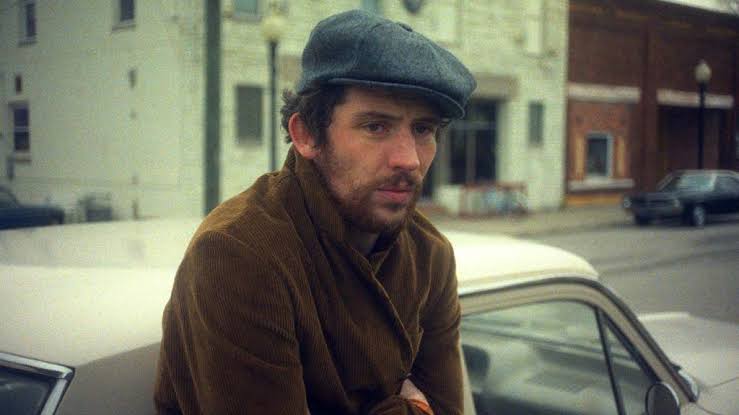
Kelly Reichardt’s “The Mastermind” is a heist film that is darkly funny and also something of a allegory about how America changed in the early 1970s. Josh O’Conner plays JB, an unemployed carpenter and ne’er-do-well who plans to steal four valuable Arthur Dove paintings from a museum in the town where he lives in Massachussets. The robbery itself is surprisingly easy but everything afterwards goes comically awry. JB gets out of being questioned by the police because his father (a wonderful Bill Camp) is a local judge but he then has to hide away with some ex-college friends who convince him to flee to a Toronto commune. He eventually winds up in Cincinnati, where JB is arrested in a Vietnam War protest he unintentionally gets swept up in. This is a beautifully-observed comedy with wonderful period production design and sublime character performances by Alana Haim, Hope Davis, Gaby Hoffman and others.
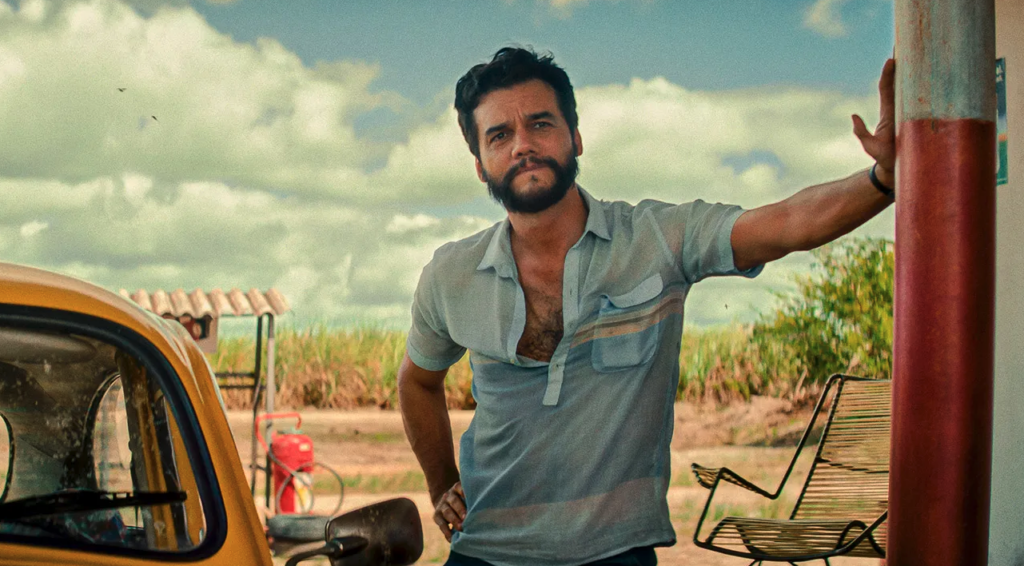
“The Secret Agent” is another film with great 1970s period flavor. It’s also a crackerjack spy thriller written and directed by Brazilian film director Kleber Mendonça Filho. Wagner Moura, who played Pablo Escobar in the 2015 Netflix series “Narcos,” gives another great performance as Armando, who goes undercover in the government of the military dictatorship in 1977 Brazil to find information about the death of his mother. Meanwhile, a corrupt Police Chief has discovered a severed leg inside a shark. Newspapers later report that the leg is alive and attacking gay men in parks at night. (Only one of several absurdists scenes in the movie.) A contract is put out to kill Armando and a flash forward reveals his surprising future. This is a highly entertaining and unpredictable thriller about a dark time in the history of Brazil. “Secret Agent” would make for a great double feature with Walter Salles’ 2024 Oscar winner “I’m Still Here.”
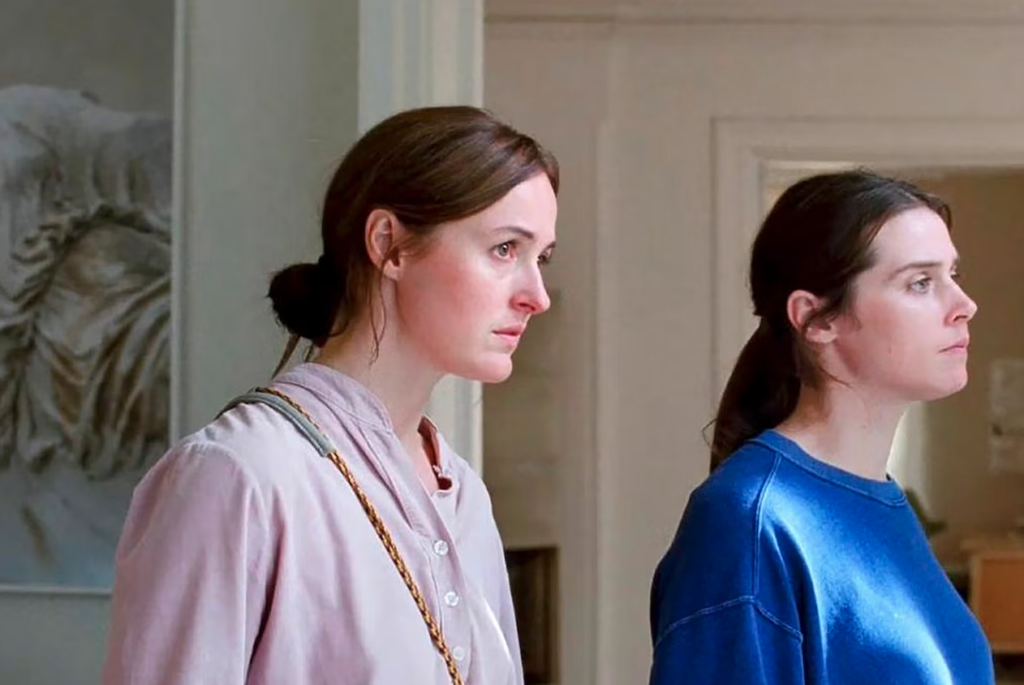
Joachim Trier, whose 2021 “The Worst Person in the World” won deserved acclaim, has created an equally sublime (but in a different emotional tone) film with his “Sentimental Value.” Renate Reinsve, so wonderful as the lead in his 2021 film, returns as Nora, a successful stage actress whose divorced father Gustav (played by the always great Stellan Skarsgård) returns after the death of her mother to reclaim the family house. Nora and her sister (Inga Ibsdotter Lilleaas) share tense relations with their father. After Nora refuses to read the part in Gustav’s latest screenplay, he offers the part to Rachel, an American actress (Elle Fanning)–this also helps him get Netflix to finance the film. Nora is angered because Gustav seems to show Rachel a breadth of empathy she and her sister never received from him. Reinsve and Skarsgård are indelible here and the film is filled with scenes that are comical and sometimes melancholic at the same time.
Also recommended:
Rebecca Miller’s five-part documentary about the life and work of film director Martin Scorsese, “Mr. Scorsese,” is a must-see for film lovers and pure candy for Scorsese fans… Scott Coopers’s “Springsteen: Deliver Me from Nowhere” is highly watchable thanks to Jeremy Allen White’s performance as Springsteen hiding away in a rented New Jersey home to work on his demo for the 1982 album “Nebraska. But it’s a bit of a formulaic music biopic and doesn’t soar like it should… Josh Safdie’s “Marty Supreme” has huge energy and artistry and a thrilling performance by Timothée Chalamet, and yet I often found it to be more irritating than entertaining… “A Private Life” has Jodie Foster speaking fluent French (she learned it as a child) as a psychiatrist mixed up in a murder mystery that would be slight without her stellar presence… Ben Stiller tells the story of his famous comedy duo parents in the documentary “Stiller & Meara: Nothing Is Lost“… “Kontinental ’25” is another absurdist black comedy by Romanian auteur Radu Jude but it’s not as radical or funny as his previous work… Noah Baumbach’s “Jay Kelly” stars George Clooney as a film star whose trip to his tribute in Italy becomes an “8 ½”-ish reprise of the ups and downs of his life and career. It’s no masterpiece but it’s mostly fun and includes another good Adam Sandler performance… Kathryn Bigelow’s “A House of Dynamite” is a riveting political thriller about a nuclear weapon (launched by an unknown adversary) aimed at Chicago that is able to escape America’s nuclear deterrence capabilities. The film is in three parts, each of which return to the beginning of the story’s timeline. Great performances by Idris Elba, Rebecca Ferguson, Jared Harris and Tracy Letts.