
In the opening scene of “The Hummingbird Paints Fragrant Songs” we see an elderly, short Peruvian woman cutting the bark off a mahogany tree. Her name is Sara Flores and the wood is an ingredient she collects to create intricate designs on textiles, following a traditional Peruvian geometrical design system called kené. Flores is unique in becoming internationally famous for her kené artwork; her story is told with poetic and quietly subversive insight in this enchanting documentary directed by Èlia Gasull Balada & Matteo Norzi. Its world premiere screening is today at the Toronto International Film Festival.
A member of the indigenous Shipibo-Konibo community of Peru, Sara has been making kené artworks since age fourteen. Kené is driven by a spiritual goal of finding order in a world of harmful practices and evil spirits. (The psychoactive decoction Ayahuasca also informs the design tradition.) The title of the film is a line from a shamanic song which associates the bird as a helper spirit.
Sara was met–late in life–with increasing fame as her work was included in dozens of international art exhibitions. We see her being celebrated in Paris as her work is featured in a new Dior handbag. She seems mildly amused by all of this fanfare; many of the fashionistas and millionaires at the event give her scant attention as she often sits alone, trying to take in this odd ritual of cultural appropriation.
Now 75-years-old, Flores uses her fame to help fight the illegal loggers who are encroaching her community’s land. We see her at the United Nations and she uses a show in Lima to fight for ecological and social justice. Bad news from her doctor leads her to suspect a neighbor has put a curse on her. She tells her tiny monkey that she misses the communal nature of her village when neighbors ate together in public.
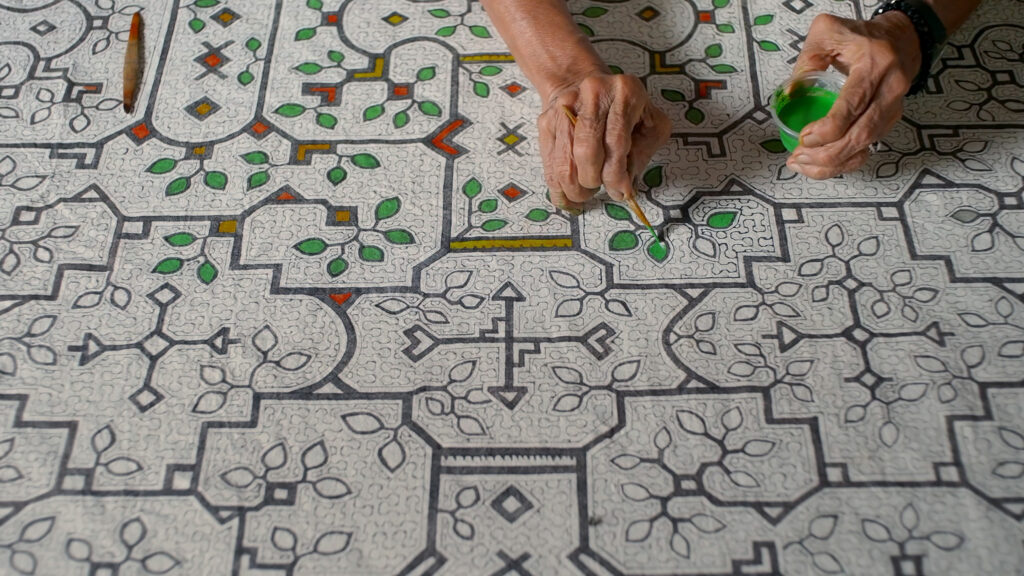
There is no narration in the film. Her story unfolds immersively by following her as she creates her artworks. Gorgeous images of her mashing ingredients to make her dyes, the natural beauty of her environment and the love she shares with her family members all create a sense of harmony interrupted humorously by moments such as her purchase of a washing machine and a TV (“You can watch your cartoons on it now,” she tells the children.) Balada & Norzi have created a remarkable portrait of an important and inspiring Peruvian artist whose work received notice not because she was a quirky outsider artist but one whose mastery of a traditional art form was recognized after decades of practice and achievement.
You can listen to an interview with the co-directors here.